

Water, Powered by the Sun: How Solar Water Towers Are Reaching Coastal Communities in Northern Mozambique
100,000+ people reached | 22 solar water towers | 30,000+ on continuous supply
ALPS Resilience water programme, Palma District, Cabo Delgado, 2022 to 2026, delivered with an energy sector client
Before ALPS began work in Palma District, some households walked 600 to 1,000 metres for water. That is roughly six or seven football pitches laid end to end, twice a day, often to a source of doubtful quality. Cabo Delgado's coast has plenty of communities like this: too spread out for a full utility connection any time soon, but in need of clean water now, not eventually.
That gap is what this technology was built to close. A borehole pump running on low voltage solar power feeds a raised tower, and gravity carries the water the rest of the way to the people who need it.
How it works
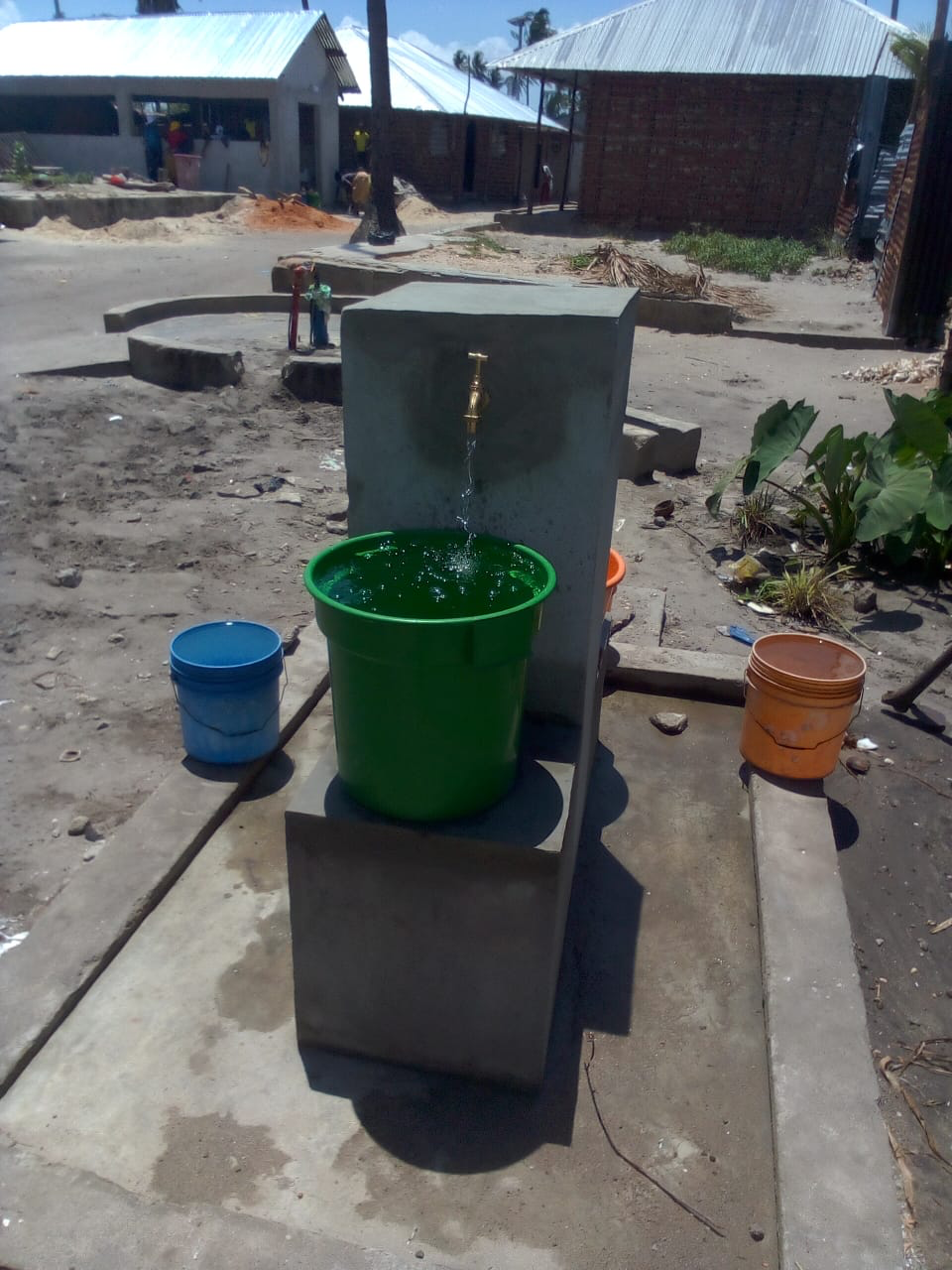
The idea is almost stubbornly simple. A solar panel array powers a submersible pump that draws water from a borehole and lifts it into a steel tower, usually somewhere between six and nine metres tall depending on the site. From there gravity does the work. Water runs down to a handful of public taps, generally around four to a tower, each one covering a different part of the surrounding community.
The simplicity is not an accident. Fewer parts means fewer things to break. Because the pump runs straight off solar power instead of through a battery, there is also less to maintain, and, it turns out, less worth stealing.
What a tap within reach actually changes
The distances involved are not an abstraction. In seven out of ten households worldwide without water at home, the job of fetching it falls to women and girls, and UNICEF has estimated that women and girls together spend 200 million hours every day collecting water. The World Health Organization draws a sharp line in its guidance: when the round trip takes more than half an hour, families typically bring home less than 20 litres per person per day, too little for basic hygiene. Bring a reliable tap within a few hundred metres and collection rises towards 50 litres per person per day, enough to drink, cook, wash, and keep children healthy.
The health effect is just as direct. Contaminated drinking water is estimated to cause around half a million diarrhoeal deaths a year, and a 2022 review in The Lancet found that a safe, improved supply close to home can cut a child's risk of diarrhoea by roughly half. The time effect shows up in classrooms: World Bank research in Ghana found that halving the time spent hauling water lifts girls' school attendance by 2.4 percentage points, with the strongest gains in rural communities.
A dependable water point also earns its keep. A study of rural piped water systems in Senegal found that gardening, livestock, and small trade around the water supply accounted for a quarter of total household income. It is a pattern Palma already confirms. Communities cluster around the water points, and at sites where the same energy sector client has funded solar lighting, people keep using them after dark, not only to collect water but as social and commercial focal points through the evening.
It is also why the technology choice matters. Roughly one in four handpumps in Sub-Saharan Africa is out of service at any given time. A solar tower that stores a day's water overhead, serves more people, and costs little to run changes the reliability equation entirely: World Bank analysis of hundreds of rural schemes found solar pumping cuts lifecycle costs by around a third against diesel, with panels that last around 25 years.
A renewable, environmentally neutral source
Palma's coastal aquifers sit at a depth of around 30 metres, and climb close to or above that level once the rainy season sets in. Sandy coastal soil takes in rainfall quickly, which is part of the reason. A study of comparable ground near Pemba, further down the Cabo Delgado coast, measured natural recharge of 210 to 350 millimetres a year, something like 30% of total rainfall making its way back down to the water table. Because each system only draws what its aquifer can replace, and rainfall tops the source back up every year, the model does not run down groundwater over time when it stays within what the site can sustainably yield.
Built to last, and built to be owned
There is no battery in this system, and that is deliberate. Humanitarian water projects elsewhere have learned much the same lesson: store water in the tower rather than energy in a battery, and the single component most likely to fail, cost the most to replace, or simply disappear overnight is no longer part of the design. Panels still need protecting, which is why they sit inside fenced, secured compounds, but with no battery on site there is no obvious high value target left behind. Communities do much of the rest. People who depend on a tower for their daily water tend to look after it without being asked to.
That combination holds up in practice. ALPS has seen towers still running after more than ten years, including some that took damage from a storm or from someone trying to strip them for parts. Getting them back to full output has usually meant replacing a panel or two and giving the borehole a clean, not rebuilding the system from scratch.

Engineering only gets a project so far. Across the Palma programme, ALPS has set up 34 community water committees, half of them with women in leadership roles, and trained committee members to maintain the pumps, spot faults early, and run the system safely day to day. ALPS also keeps a direct line open to local infrastructure authorities, so each installation fits into wider district planning rather than sitting apart from it. One team sees a project through, from the first site visit to handover and beyond.
A foundation, not a finish line
These towers are a first step, not a finished answer. ALPS is already looking at how this model can grow into a wider piped network as an area develops, using the towers and fountains already built as anchor points rather than infrastructure to be replaced later. There is good precedent for building this way: a World Bank study of village energy systems in Cambodia found that more than 250 small local networks were not scrapped when the national grid arrived, but were converted into licensed local distributors and folded into the larger system. Build well the first time, and early infrastructure becomes the seed of the network that follows rather than its casualty.
The same thinking applies to power. In rural Mozambique, fewer than one household in ten has access to electricity, which means a solar pumping array is very often the first permanent power installation a settlement has ever had. Solar makes sense today because it is the most reliable option where the grid has not arrived. Once electrical infrastructure does reach these areas, the same control systems are designed so the pump can draw from the mains through a small transformer instead, with solar kept on hand as backup rather than written off as a sunk cost. And the first of those next steps is already visible in Palma: solar lighting added at a number of water points now keeps them alive after dark, so that the working day does not have to end at sunset.
A model ready to travel
Everything above was built to be repeated. The design is standard, the parts list is short, the skills stay in the community, and the running costs after handover are low. That makes a solar water tower one of the rare pieces of infrastructure that can be specified once and rolled out across many communities without starting again from the ground up.
ALPS is now mapping where this model should go next, across Cabo Delgado and beyond, and we welcome conversations with partners and funders who want water infrastructure that is still working a decade after handover. Get in touch.
ALPS Resilience delivers water, sanitation, and infrastructure programmes across Mozambique, South Africa, and Ukraine, working directly with communities from the first assessment through to long term maintenance.


Comments